We built a tool to tear down hotel websites. We pointed it at ourselves first.

We built a tool to tear down hotel websites. We pointed it at ourselves first.

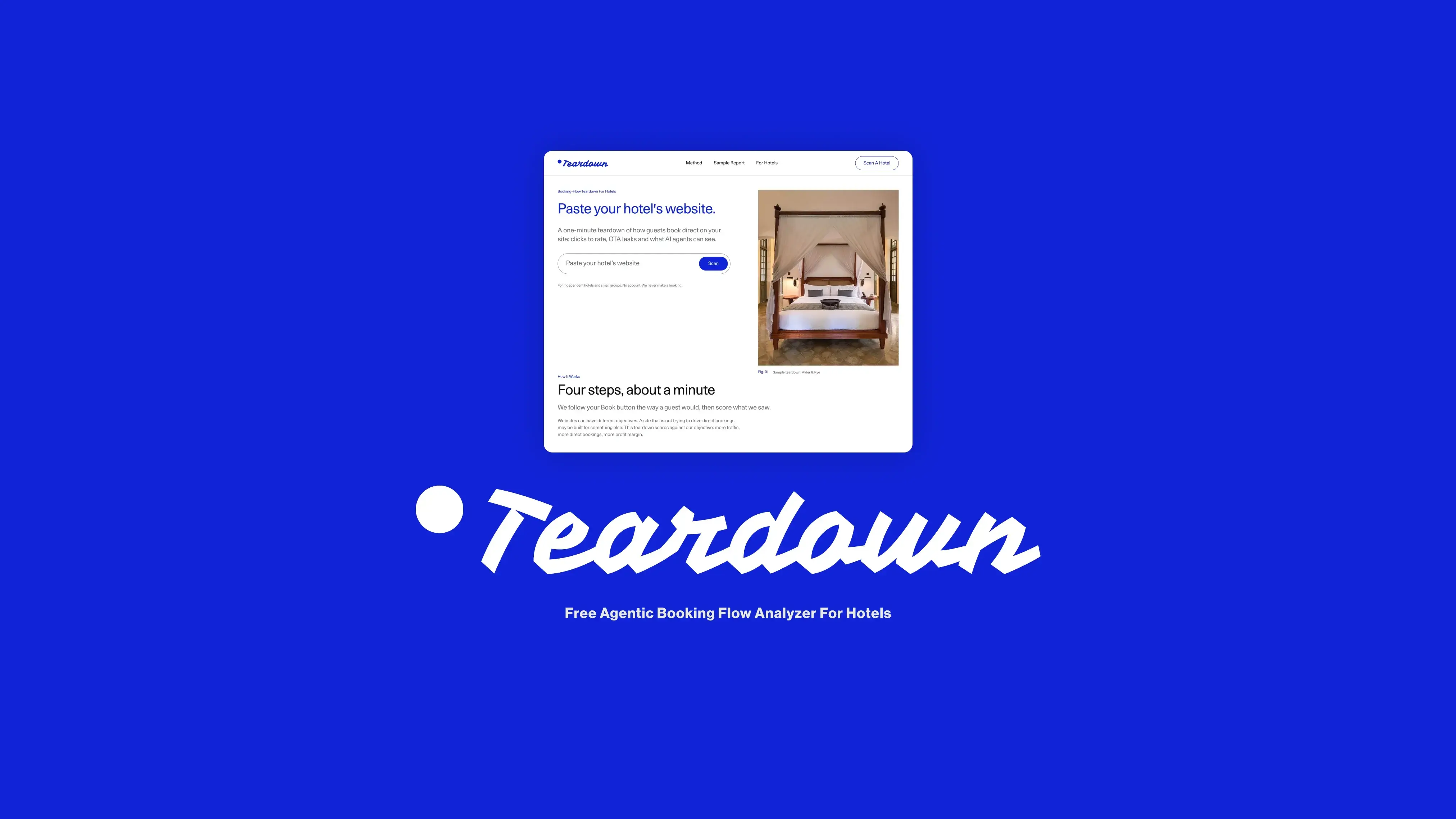
The tool is live and you can use it here https://hotelteardown.shrimpton.agency/

Most agency "audits" are a sales deck wearing a lab coat. Someone screenshots your homepage, writes "consider improving UX" in a grey box, and sends an invoice. I've been designing and building websites since 2008, and I've seen enough of those to be allergic to them. So when we wanted a sharper answer to the question every hotel owner eventually asks us, "why are guests booking us on a travel site instead of direct?", we didn't write a deck. We built a machine that goes and looks.

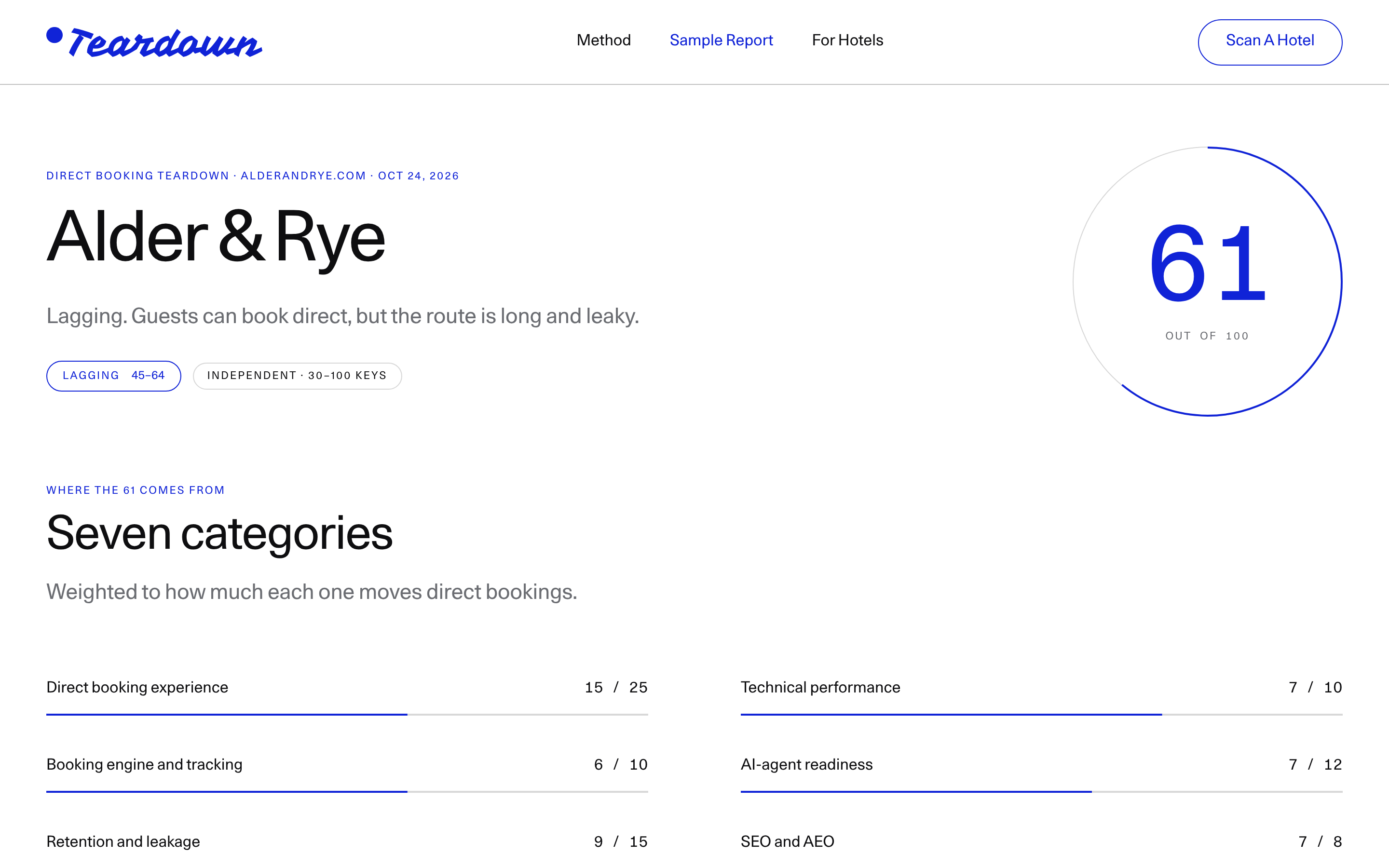
It's called Hotel Teardown. You paste in a hotel's website. It opens the site on a phone, finds the Book button, taps it, and follows the route all the way to a visible rate, counting every click, every hand-off to another domain and every link pointing guests somewhere else. Then it scores the site out of 100.

We built it for us. It's how we test a hotel's direct booking path, which is the thing we double down on for every hotel we work with. Here's what it does, how we actually use it, and what it found when we pointed it at our own clients.

Traffic is a cost. Direct bookings are the point.

I'll say this plainly because the industry rarely does: driving lots of traffic to a hotel website is pointless if that traffic doesn't book direct.

We're big believers in SEO. I wrote about why in SEO like it's 2014, AI Search for tomorrow: organic search is brand-owned, compounding traffic that keeps working long after an ad budget stops. In that piece I also said that if your SEO agency doesn't measure results in increased sales revenue, they're not worth the paper their contract is written on. For a hotel, revenue from your website means one thing: direct bookings.

Here's the bit that hurts. A guest who finds you through a lovely long-tail search ("best boutique hotels in Savannah with rooftop bars") and then hits a slow, confusing or leaky booking path doesn't just disappear. Plenty of them go and book you anyway, on a travel site, and you pay that site a commission for a guest your own marketing found. You did the expensive part. They took the margin.

So in our hotel work, SEO and the booking path are one job, not two. More traffic into a leaky path just means feeding more guests to the OTAs. Fix the path first, then turn up the traffic. Hotel Teardown is how we check the path.

Why we build our own tools first

Most agencies sell opinions. Good ones sell informed opinions. The difference is evidence, and evidence is boring to collect by hand.

For years our honest process was: open the site on a phone, tap around, screenshot, count clicks, check what the booking engine does to tracking, view source, run a speed test, write it up. It works. It's also slow, inconsistent between people and impossible to compare across fifty hotels. So we automated our own homework:

  • We're the first user. If a tool doesn't change what we'd recommend to a client on Monday morning, it doesn't ship.
  • Insight before selling. As a hospitality technology agency, the most useful thing we can bring into a room isn't a mood board. It's a clear picture of what happens when a guest tries to give the hotel money.
  • Same test, every time. A script doesn't get tired, skip the mobile check, or go easy on a site because it's pretty.

It isn't the first time we've done this. We built a free teardown tool for online stores on the same principle: build the thing that tells us the truth, use it on real work, then open the door.

What Hotel Teardown actually does

No magic, no "AI-powered insights" fog. Paste a URL and it:

1. Opens your site like a guest on a phone. The homepage loads at 390 × 844. If there's a cookie banner, it picks reject or necessary-only; it never consents on anyone's behalf.

2. Follows your Book button. It finds the first visible Book, Reserve or Check availability control (skipping restaurant, spa and voucher links), taps it, follows new tabs, and keeps going until a price appears, counting clicks, domain hand-offs, new tabs, and whether the analytics linker survives the jump to the booking engine.

3. Counts the leaks. Links to Booking.com, Expedia, Hotels.com, Tripadvisor, Agoda, Trivago, Kayak and more on the homepage and booking path, on phone and desktop.

4. Checks what AI agents can see. Hotel structured data; whether rooms, rates and policies can be read without JavaScript; llms.txt; AI crawlers blocked by accident; SEO basics; and a mobile Lighthouse run.

It also identifies the booking engine (SynXis, Cloudbeds, Mews, SiteMinder, Guestline, D-EDGE, Profitroom and plenty of others). What it won't do: fill in a form, sign in, or click anything that pays, confirms or submits guest details. It respects robots.txt. It behaves like a curious guest and stops before the part where it would be rude.

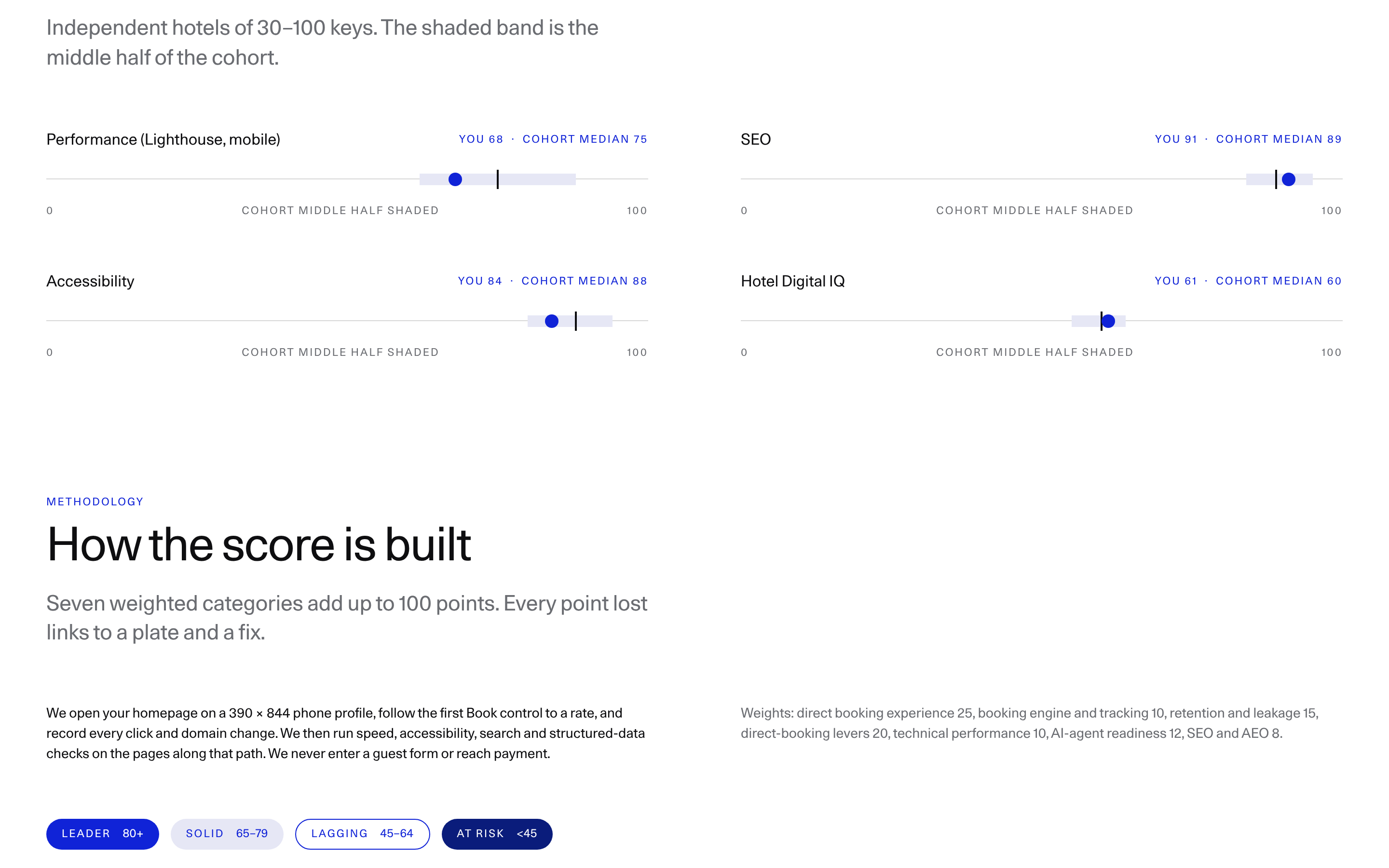
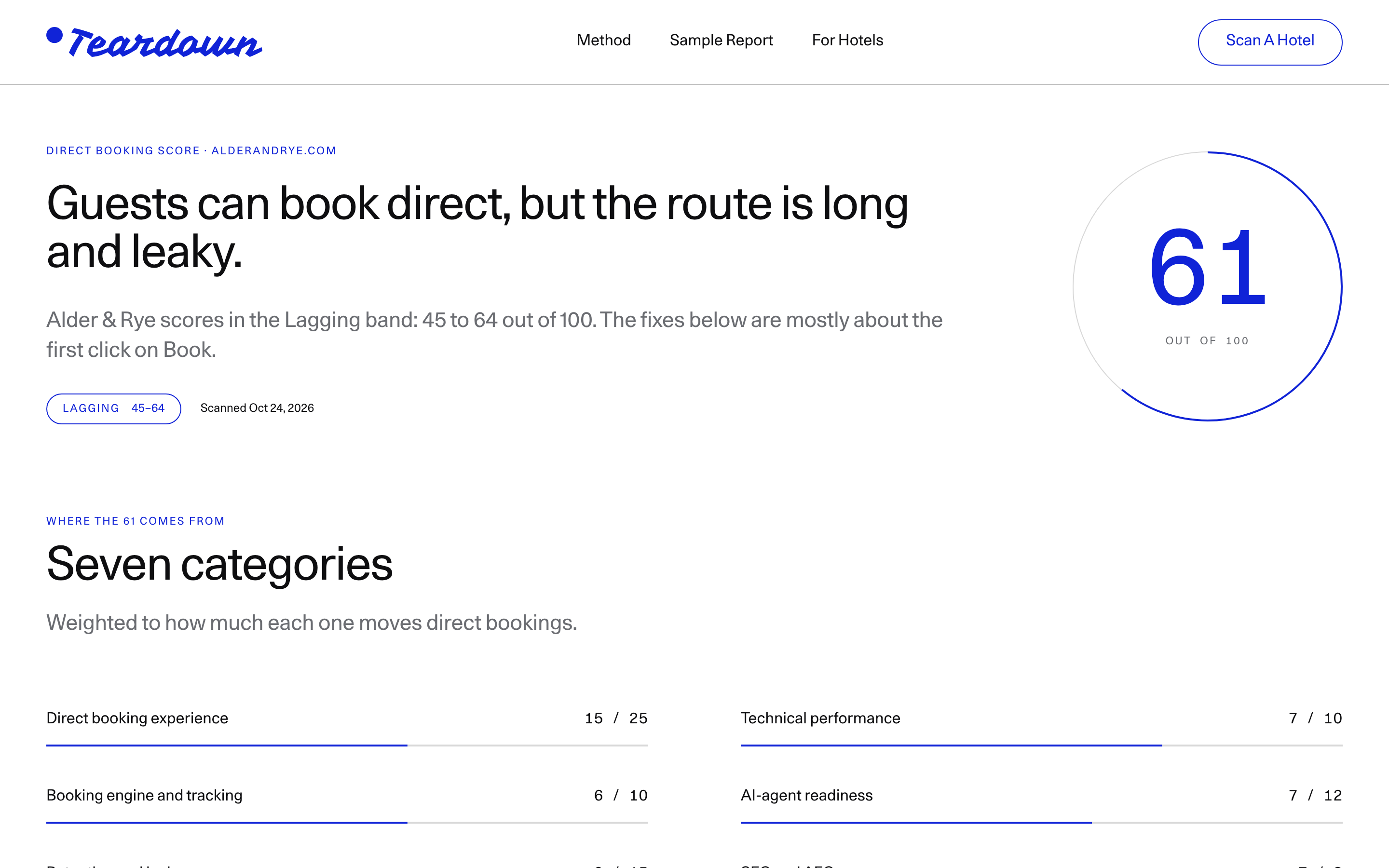
Everything rolls up into a 100-point Direct Booking Score across seven weighted categories:

Category Points
Direct booking experience 25
Direct-booking levers 20
Retention and leakage 15
AI-agent readiness 12
Booking engine and tracking 10
Technical performance 10
SEO and AEO 8

Notice SEO sits at the bottom. Not because it doesn't matter (see above, at length), but because this tool measures what happens after the guest arrives. Scores land in four bands: Leader (80+), Solid (65–79), Lagging (45–64) and At risk (under 45). The score and top three leaks are free; the full report, with up to ten findings, screenshots and a fix for each, unlocks with a work email on the hotel's own domain.
We built a tool to tear down hotel websites. We pointed it at ourselves first.

How we actually use it to test a direct booking path

This is the part I care about most. Hotel Teardown isn't a lead magnet we bolted on. It's in our process at three points.

Before a pitch or an audit. We scan the hotel before we've said a word. It changes the conversation. Instead of "we'd love to refresh your brand online", we can say "your Book button leaves your site after one click, there's no price until a guest picks dates, and your analytics loses them at the hand-off." That's a conversation about money, which is the only one a GM actually wants to have.

During a project. The findings become the brief for the booking path. Every leak has a points value, so we can prioritise by what moves direct bookings, not by what's most fun to design.

After launch, and again after every big change. We rescan on launch day, then again whenever something touches the booking path: a new booking engine, a redesign, a tag manager clean-up, a "small" homepage update. Booking paths break quietly. A new cookie banner covers Book on a phone. Someone adds a "Compare prices" badge. The linker stops passing. Nobody notices until revenue does. A rescan is our regression test.

Whenever we run it, these are the things we look at first:

  • Clicks to a price. How many taps from the homepage until a guest sees a rate. Every click past three costs points, because every click is a chance to leave.
  • Domain hand-offs. Does Book send the guest to the booking engine's domain, and does it open a new tab? You lose your header, your rate promise and your design the moment that happens.
  • Tracking across the jump. If the analytics linker doesn't survive the hand-off, your reports credit the booking to "referral: booking engine" or lose it entirely. Then you can't prove your SEO is working, and someone cuts the budget that was.
  • A rate before dates. Does a guest see any price before they commit to dates? A blank calendar is a fine experience for someone who's already decided. It's a dead end for everyone still comparing you against a travel site that shows a price instantly.
  • OTA leakage. Travel-site links and review badges sitting on the path to your own rate. You're advertising someone else's checkout.
  • Email capture. Most visitors don't book on the first visit. If you never ask them to stay in touch, the travel site's retargeting will.

What it found on our own clients

We've only just switched it on, so I won't dress three scans up as an industry study. But the first thing we did with the live tool was point it at hotels we work with, sites we know well. The results were useful precisely because they're good sites.

Three real scans, run on October 29, 2026:

  • A boutique hotel we work with: 76 out of 100, Solid. A rate in two clicks. Zero travel-site links on the booking path.
  • A design-led city hotel we work with: 67, Solid.
  • A downtown hotel we work with: 63, Lagging.

Nobody scored At risk. Nobody scored Leader either. The same three problems came up again and again:

1. Book leaves the hotel's own site. The top leak on all three: after two clicks on the 76, after one on the others. That's normal (most hotels use a third-party engine), but it's exactly where the brand, the rate promise and often the tracking fall off a cliff. Fix: keep the booking panel on your own domain where you can, and make sure tracking follows the guest across.

2. No rate until guests pick dates. Two of the three. Tap Book, get a calendar, not a price. Fix: show a "from" rate, or open the picker with sensible default dates so there's a price on screen straight away.

3. No hotel structured data. All three. Not one told machines, in a structured way, that it's a hotel, where it is and what it offers. AI-agent readiness was the weakest category across the board: 7, 7 and 3 out of 12. That stung, and it's exactly why we test our own work first. Fix: Hotel schema with address, check-in and check-out times, amenities and policies. An afternoon's work, not a rebuild.

The good news: all three scored 13 or more out of 15 on retention and leakage. None was littering the booking path with travel-site badges. Some hotels do. These don't.

We built a tool to tear down hotel websites. We pointed it at ourselves first.

The myths this kills

"Our booking engine handles conversion." Your booking engine handles a transaction. Getting the guest to it, and convincing them it's the best place to book, is your website's job.

"We need more traffic." Maybe, later. More traffic into a leaky path is more guests handed to the OTAs. Fix the path, then turn up the volume.

"We need a redesign." Maybe. But half these findings are an afternoon's work: move a badge, add a line of copy, add a date picker, fix the linker. A teardown tells you which problems are cosmetic and which are structural before you spend a penny.

"AI search is a future problem." It was the weakest category in every real scan we've run. If your rates and policies only exist inside a widget that needs JavaScript and a click, you're invisible to anything that doesn't behave like a patient human.

Try this on your own phone tonight

  1. Tap your own Book button. Count the clicks to a price. Over three? That's your first project.
  2. Notice when you leave your own domain, and check your analytics follows the guest there.
  3. Clear travel-site links off the booking path.
  4. Put one reason to book direct next to the price: best rate, breakfast, late checkout. Pick one.
  5. Ask for an email before they go.
  6. Make rooms, rates and policies readable without JavaScript.

None of that needs us. Honestly.

How it shapes our client work

Hotel Teardown changes the order we do things in. When we built the website for the Municipal Grand Hotel in Savannah (forty-four rooms, a restaurant, two bars, one pool, in a former bank building), we went headless: Nuxt on the front end, Storyblok as the CMS, Netlify for hosting. That kind of build gives you control over exactly what the teardown measures: where Book sits on a phone, what renders without JavaScript, what structured data ships on every page. Hotel Teardown itself is built in Nuxt too, because we use what we recommend.

Our drinks and lifestyle work, for brands like SirDavis, Casamigos and Blind Barber, taught us the same lesson: whether you're selling a room or a bottle, the money is made or lost in the last few clicks. So before we propose a design, we run the scan. Before we pitch a change, we know what it's worth in points. When the project ships, we run it again. It keeps us honest as much as anyone.

We built a tool to tear down hotel websites. We pointed it at ourselves first.

Try it on your own hotel

Hotel Teardown is built for independent hotels and small groups. Paste your website at hotelteardown.shrimpton.agency, get your score in about a minute, and unlock the full report with your work email.

If you'd rather we walked through it with you, the report ends with an option to apply for a Direct Booking Audit, or just get in touch. We'll start where we always start: by looking.

Ben Shrimpton is the founder of Shrimpton Agency, a hospitality technology agency in Los Angeles and London.

Back to all articles